
München – 12., 13., und 14. Tag
Die letzten 3 Tage: Autos, Gebäude, und Essen – Aaron und Liam
Für drei Tage sind wir in München. Die Stadt ist groß, aber die Gebäude sind kleiner als in Frankfurt und Berlin. München ist die letzte Stadt für unsere Reise. 😦
Ein interessantes Element über die Gesellschaft in Deutschland ist, dass so viele Autos sind Kombiwagen. Es gibt weniger Kombiwagen in der USA. Ich fahre einen Kombiwagen und mein Auto ist ein kleines Auto, verglichen mit dem, was die meisten Leute in der USA fahren. Aber viele Autos in Deutschland sind kleine Kombiwagen. Es gibt nur ein paar große Autos in Deutschland. Aber Kombiwagen sind relativ sehr geräumig, praktisch, und effizient mit Treibstoff. Kombiwagen sind weniger verschwenderisch und daher für Deutsche attraktiver.

Viele Autos sind auch nicht importiert. Deutsche Autos (Volkswagen, BMW, Mercedes) sind überall. Da ist relativ mehr Autos als in der USA importiert.

Ein anderes Beispiel über die deutsche Gesellschaft ist über die Fensterblenden. Ich habe an einige Anlässe Fensterblenden von Fenstern gesehen. Ich habe keine Ahnung darüber, wie diese Fensterblenden sind aus die Gebäude. Ich denke das war eine Idee von der 50er oder 60er Jahre Konstruktion. Da waren viele Gebäude mit diesen Gesetzmäßigkeiten. Es wurde umgebaut in den 50er und 60er Jahren nach dem 2. Weltkrieg. In diesen Jahren hatte man andere interessante technische Ideen gehabt. Ein anderes Beispiel ist der Aufzug im Rathaus Stuttgart, der keine Energie benutzt. Das erste Bild ist ein Beispiel von dem Gebäude in der Technischen Universität Braunschweig:

Dieses zweite Bild ist ein Gebäude in München mit den interessanten Fensterblenden:

One cultural observation that I found very interesting was the bathroom situations in Munich and in this country. I found it very interesting how, for most if not all public restrooms, require you to pay a fee to use, something that would never occur anywhere in the United States. Along with that the bathroom layouts are, for the most part, cleaner than they are in the United States and that layout of them are different with instead of using a knob to flush they have buttons for either a small or large flush depending on how much force you need, something that isn’t in the United States or is extremely uncommon. Another thing to add on to that is how in Germany all of the bathrooms have doors separating the sinks and the toilet area, something that isn’t common in the USA, and something that I myself find better due to feeling as if I have more privacy and that the bathrooms are a lot larger and are taken better care of in general.
Another cultural observation that I observed while my time in Munich or Bayern itself is that unlike other parts of Germany where there are dialects present throughout the country, the Bavarian dialect is something I’ve never encountered or thought that I would encounter while my time in this country. While in the other parts of the country I was able to formulate and understand a decent amount of what some of the native people were saying with the dialect they possess, but listening the Bavarian dialect it almost feels as if I’m listening to another language inside Eastern Europe, and it makes me think even more that not all Germans speak Hochdeutsch and that they speak almost their own kind of language.
Another observation that I found interesting while in my time in Munich is the food and the culture around the town and the state of Bavaria. While exploring the town I’ve encountered Germans wearing the stereotypical Lederhosen both in public and in restaurants. Whether it be to attract tourists inside shopping districts and restaurants or it to even celebrate their own culture on a day that doesn’t fall on Oktoberfest, I found it very interesting to see how the different part of the country really do have their own specific culture, as in the United States as well. Also, the stereotypically German cuisine and food of a lot of meat such as Bratwursts and Currywurst to the famous Brezel mit Butter was seen a lot more prevalent in the restaurants inside of this specific state.


Krankenhausbesuch in München
Michael C.
During the trip, I received an injury to my knee and had to go to the Emergency Room, or Notaufnahme. The Wartezimmer was much smaller compared to the U.S. There was space for about 15 people to have a seat. The process was to have nurse see what is wrong, wait for the doctor, get tests that the doctor says, and wait for him to analyze the tests. After going through the process, I noticed few things that were different than the U.S. First was the people operating the machines spoke little to no English compared to those at the doctor and the reception. Another difference was the price of the visit, a little over 100 Euro, with the most expensive part of the visit being the Krücken. Finally, I received no escort by a medical professional when I was on my way to get the X-ray. In the U.S. this is a very rare occurrence, if it even does happen. The doctor was very nonchalant about it, like it was normal. It was a bit of culture shock at the Notaufnahme, but an experience I will not forget soon.

Stuttgart – 11. Tag
Graffiti, Parks, und Marktplätze – Pat und Mike C.
In vielen deutschen Städten kann man viel Graffiti sehen. Graffiti gesehen werden auf Gebäuden und auf der Wand in Bahnhof und Tunnel. In den USA kann man Graffiti sehen, aber es ist nicht gewöhnlich. Heute sind wir zum Mercedes-Benz-Museum gegangen und haben in einem Tunnel viel Graffiti gesehen. In diesen Platz kann man rechtlich Graffiti machen. Das meiste Graffiti hat sehr schön ausgesehen. Straßenkunst wird nicht so viel in USA geschätzt. Man kann nicht in der Öffentlichkeit Wand-Graffiti machen.


Parks are fairly common in most towns strewn about Germany. They can come in all shapes and sizes, sometimes have attractions that would make them more appealing. Today we had the pleasure of seeing a unique, but small park. The park contained a metal ping-pong table and foosball table. They did not have any of the equipment to use them, i.e. the ping-pong paddles and balls to play with. The park had a gravel-dirt like ground, with very little greenery instead. Given that it is the middle of winter upkeep of the park was most likely not the highest priority for the city. Another unique attribute about this park was the location. On one side of the park was a cliff, with a guard rail on it, and the other was a busy road. A park in a place like this would be rare in the U.S., if there are any. Finding places like this is what makes exploring Germany fun.


Heute haben wir in einem Markt Mittagessen gegessen. Auch sind wir in Frankfurt zu einem Markt gegangen. In diesem Markt kann man Obst, Fleisch, und viele Arten von Essen kaufen. In Amerika kann man die gleichen Märkte finden, aber es wird nicht so geschätzt.
In down Stuttgart there is big Wochenmarkt, or farmers market. The market only contained all types of fresh food, fruits, vegetables, meat, and breads. After some exploring it appeared that was the only place in the area to buy anything fresh. Every stand had their own theme of what type of product being sold. Some stands only had meat, others only contained fruits and vegetables, it even contained a bakery. Some of the butcher’s places had untouched animal legs, ready to be processed when someone orders a part from it. Unlike a supermarket, like stop and shop or whole foods, you paid at the stalls for what you got there, rather than pay for everything as you leave. Another difference the farmers market had with the U.S is how they are permanently there. Overall, I found it to be a unique part of Germany that I wish was common around URI.

Ludwigshafen und Stuttgart – 10. Tag
Monika und Kayla
In Deutschland gibt es viele kleine Dinge zum Essen, die sich von den Vereinigten Staaten unterscheiden. Zuerst, sie kommen in ein Restaurant und bestellen Getränke. Sobald Sie die Getränke erhalten haben, sagen Sie “Prost”, während Sie Augenkontakt herstellen und Ihre Getränke miteinander anstoßen. Dann, man muss darauf warten, dass jeder am Tisch sein Essen hat. Sobald jeder sein Essen hat, sagt man “Guten Appetit.” Dann können Sie anfangen zu essen. Ein weiterer Unterschied ist, wie sie das Besteck halten. Man hält immer ein Messer in der rechten Hand und benutzt die Gabel in der linken. Sie halten die Utensilien während des gesamten Essens so. Sie essen auch fast immer mit Utensilien und niemals mit den Fingern.

Die seltsamsten Nahrungsmittel, die man mit Utensilien essen kann, sind Pommes Frites und Burger, die Amerikaner immer mit ihren Händen essen. Eine Ausnahme ist der Döner!

Heute wir viele Busse genommen. Während der Busfahrten bemerkten wir, wie viele Straßenschilder unterschiedlich sind. Es gibt nicht viele Straßenschilder, die so “spezifisch” sind wie in den USA. Beispielsweise werden wichtige Zeichen wie Stoppschilder “STOP” ausgesprochen. Die Straßenschilder hier sind sehr einfach. Viele Dinge, die verboten sind, sind durch einen roten Kreis und die verbotene Sache in der Mitte gekennzeichnet. Wir haben Stoppschilder gesehen, wie wir es normalerweise in den USA tun würden. Geschwindigkeitsbegrenzungen sind auch mit einer Zahl in der Mitte sehr einfach, aber wir müssen wissen, dass sie in Deutschland kmh und nicht mph verwenden. Ein Straßenschild, das in den USA nicht oft zu sehen ist, ist das x innerhalb eines Kreises. Dieses Schild weist den Fahrer darauf hin, dass es keine Haltestellen gibt.

In Deutschland ist es sehr wichtig, nicht “Jaywalk.” Sie müssen nur am Fußgängerübergang überqueren und auf das grüne Licht warten. Dies ist auch eine Regel in den Vereinigten Staaten, die jedoch sehr oft gebrochen wird. Es ist wichtig, diese Regel in Deutschland aufgrund der öffentlichen verkehrsmittel zu beachten. Eine Straßenbahn und Busse fahren schnell und können von dort kommen, wo Sie warten müssen, bis Sie die Straße überqueren, bis sie frei ist. Ein Unterschied zu den Ampeln ist, dass sie manchmal in einer etwas anderen Reihenfolge leuchten. Das Licht geht grün, gelb, rot, gelb, grün. Das gelbe nach dem roten Licht ist also neu und ich denke, es ist eine gute Idee.
Heidelberg – 9. Tag
Cathy und Katie
As even a modern town, Heidelberg still shows its old roots. The Straße are narrow and winding, built out of cobblestones. With the entire group walking together, we blocked the entire width of these small roads. Areas like this are not common in modern areas of Germany, or the old areas that have been reconstructed. Today’s die Bauverordnungen prevent the tight streets from ever being built again. Narrow roads can’t accommodate two lane roads for cars, and cause issues for housing. Requirements today ensure that Nachbarhäuser can’t set the ones next to it on fire. But in the past, the thought was to simply to fit as much housing into the city – and cars didn’t exist. Heidelberg’s older buildings survived after WW2, unlike much of Frankfort’s Altstadt – which has been reconstructed today as Neue Altstadt. In Frankfurt’s Neue Altstadt, regulations prevented the old buildings from being reconstructed exactly as they were formerly. In Heidelberg, these old hazardous-but-quaint characteristics can still found.

Even though the streets may be narrow, you can still find plenty of open space in the city. Ein Platz is a noticeable characteristic to any German city, even modern ones. The open city square has space for people to gather, is usually located by an religious or government building, and may have a statue or a fountain. American cities and town commonly lack these central places because newer cities have been planned for the use of the car. Throughout history, ein Platz was used for functional purposes. They are often used as ein Marktplatz. Lots of times, the Rathaus is there so the Rat can give announcements from the building’s balcony. Since many could not read in the past, a collective gathering was the most effective way to spread news. Today, they still provide space for meeting up with friends and enjoying the sites of a historic city, as one might do in Heidelberg.

As we make our way through Heidelberg, we take note of the fact that Germans do not like to be wasteful. There are countless examples of this involving serving size, restaurant etiquette, and building heating. Serving sizes at the hostels are noticeably smaller than the common “American” portion. The cups offered during meals at the youth hostels are always four ounces versus the eight-ounce cup most of us are used to. When our group ate lunch in the heart of Heidelberg, we saw that waiters/waitresses did not rush your meal at any point during your visit. In America often times, servers will advance to clear the plates off the table while you may still be eating; sometimes they will leave the check on the table for “your” convenience. While dining in Germany, servers do not approach you at any time unless you are asking something of them, which is vastly different from the United States. Many Germans would find it fairly offensive to be handed a check before it was requested. The most blatant example of conservative behavior was the lack of heating in the stairwells. In most-all buildings we have entered, not a single stairwell was heated. There is a good reason for this, considering stairwells are not a living space.
Not only in Heidelberg, but the majority of places visited in Germany have many more accommodations for handicapped people than in the United States. For example, at every train station and bus station we have taken note of the additions added to the pavement. These additions are white strips, about 6 inches wide that run along the sidewalks; they have clear extrusions in order for the visually impaired to feel their way around the tracks. These helpful indents in the pathways are nearly nonexistent in America, which is why such a simple feature stood out to us.
Frankfurt – 7. und 8. Tag
Andrew und Michael M.
Frankfurt, despite being known for nicknames such as “Mainhatten”, has a culturally rich historic district that is home to much of German history, dating back to the first century. Today, we observed the newly reconstructed places within Frankfurt. With the help of the Bettensteuer, or “Bed tax”, tax funds gained from the purchase of lodging services funded the restoration and rebuilding of historic Frankfurt. It is interesting on how there is a German sense of memorialization and preservation when it comes to old architecture. I do not believe that such a tax would have worked in the states, especially when it comes for empathy of building styles through modern generations. We even see that at U.R.I., where many students despise the brutalist architecture of the fine arts building. While there is still some preservation of older buildings, like the Slater mills, but I have not seen such effort and attention to detail as historic Frankfurt.

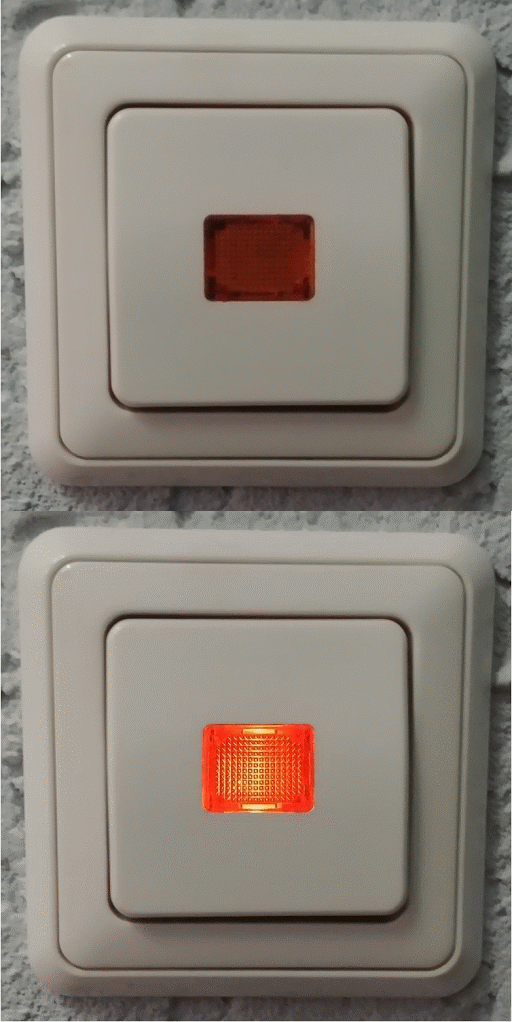
German electrical interfaces are fairly different from the United States. Our first encounter was with the electrical outlet. They are two cylindrical prongs as opposed to two thin prongs used in the states, with different grounding tabs. In some cases, you even can have safety outlets, which require you to insert the plug and rotate it one-quarter of a turn before the plug goes in. On the topic of light switches, they have always been rectangular and much bigger here than the US. Instead of a small switch, you flip the whole rectangle to turn the lights on. Additionally, you can sometimes find a dim light that will glow when the lights are off to help you find the light switch in a dark room. This is different compared to the smaller toggle switch style found in the states.
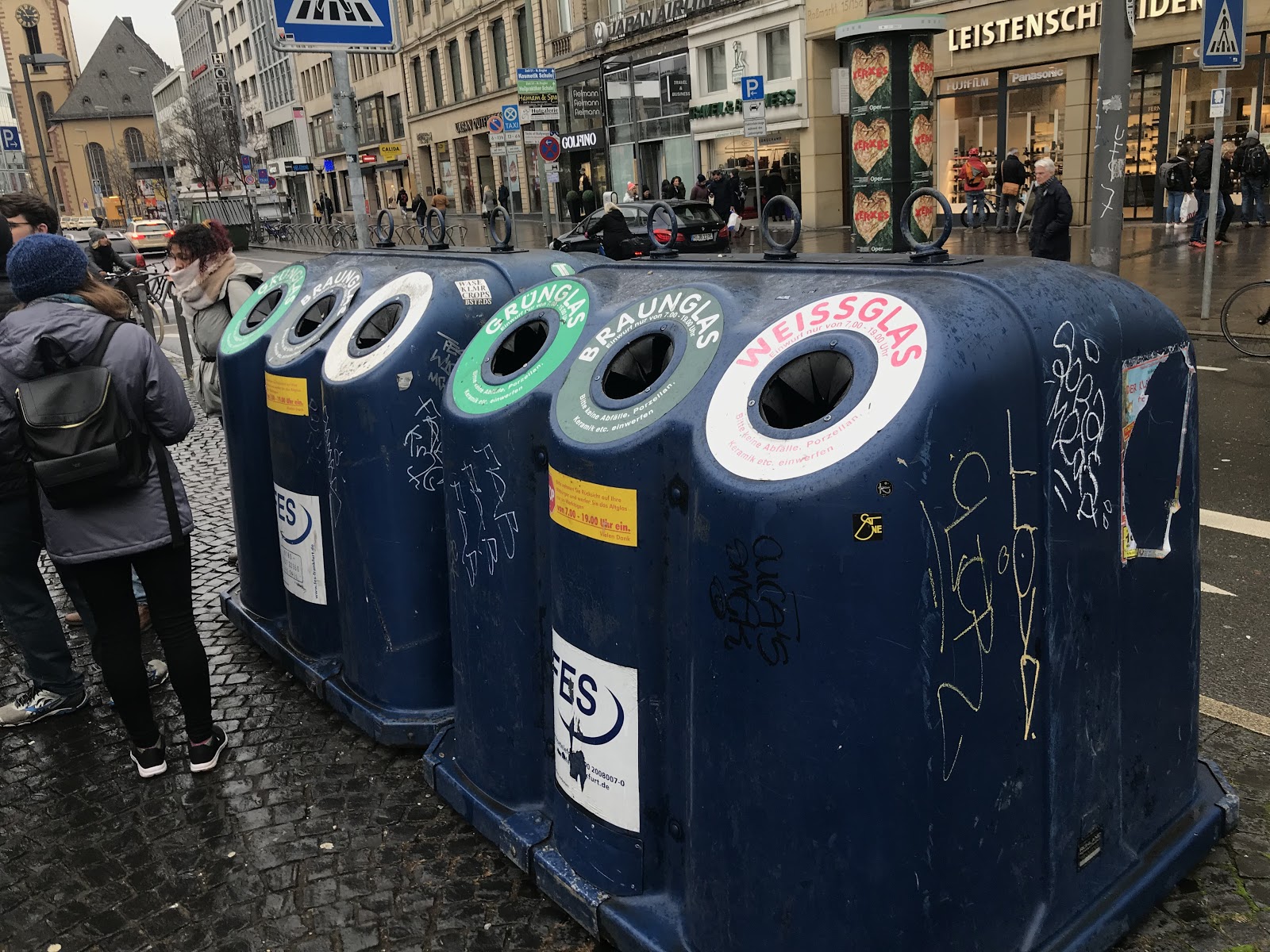
One major cultural difference I have noticed is the mindset on recycling here. There are recycling bins that separate each type of glass and you can find them on many streets in the city. In the United States, most bins are for mixed recyclables only, if you can find one. As seen in the picture below, German recycling receptacles have a bin for “clear” white glass or (Weissglas), Brown-tinted glass (Braunglas), and Green-tinted glass (Grunglas). Another difference in recycling is that bottles often have a tax on them when you buy them at the store. It’s usually around €0.15, which you can usually get back after returning them, giving you an incentive to reuse and recycle.
Darmstadt – 6. Tag
Fahrräder, Bettwäsche und Straßen – Keevan und Radhilka
 A big difference in Deutschland is the large use of Fahrrads (bicycles) as a form of transportation. Every city has designated Fahrradweg (bike path) on each sidewalk or the street, and every pedestrian knows to stay out of those zones, except for us who are not used to this and forget as it just looks like a normal part of the sidewalk. So when you hear the bells of the cyclist, you should move out of the way quickly because they will not stop. There was a slight difference to this in Darmstadt however. From what we saw in the city, the Fahrradweg and the pedestrian sidewalk was just formed into one and not seperated. This threw me for a loop in particular as I was just getting used to the separation from cyclists and pedestrians from the past couple of cities. Also, another difference in Darmstadt compared to the past cities that I noticed many more people that had mopeds and scooters to get around as well as Fahrrads. This was just an interesting thing to see and made me curious as to why only this city had many more mopeds and scooters than the others that were prominently just Fahrrads.


In Hostels müssen Sie die Bettwäsche auf Ihr Bett legen. Wenn Sie das Hostel verlassen, müssen Sie die Bettwäsche von Ihrem Bett nehmen, um gereinigt zu werden. If you go to any hotel, inn, or motel in the United States, your bed will be already made for you. In the United States, you can just leave the bed as is and the maids will take care of everything for you. Even though setting your sheets and pillow is not a hard task at all, it is just interesting to see that there is just that one thing to do once you get to your room and when you leave, going from entering your room all ready to go to this was just a little bit of difference that we hadn’t even thought about.

As we arrive to the city of Darmstadt, we realize the the city’s street are actually divided differently than they are in the United States. We noticed that in some street they added an extra lane for the Straßenbahn that they sometimes share with the buses. In Rhode island, we don’t see a separate lane in the middle of the street for the buses, they may be one for the Straßenbahn, but the buses usually share the lanes with the rest if the cars. Another difference between how the roads are different is the fact that they the two opposite lanes are not divided by a yellow line, but by a solid white line. The first time I noticed that I thought a car was driving in the wrong direction because they weren’t any visible separation between the two lanes. This may be confusing for someone who comes from the US and tries to drive.
Wolfsburg und Braunschweig – 4. und 5. Tag
Will und Scott
Viele Leute, die bei der Firma Volkswagen arbeiten, fahren mit dem Zug zur Arbeit. Wann wir in Wolfsburg angekommen sind, sah es aus dass es nicht so viele Häuser in der Nähe von dem Bahnhof gab. Wolfsburg ist ja relativ klein, mit nur quasi 120.000 Bewohner. Ich lernte bald dass viele der 70.000 Arbeiter nicht in Wolfsburg wohnen. Ziemlich viel wohnen in Braunschweig und in diese Stadt pendeln ein. Die meisten Braunschweiger haben kein Auto dabei, also wird der Zug sie nach Wolfsburg bringen. Ich fand es interessant, weil das mich an zuhause erinnert. Für mich ist zuhause dicht bei New York City. Jeden Wochentag fahren die Arbeitsleute durch Connecticut mit dem Zug zur Stadt und kommen vor dem Abendessen zurück. Das Gleiche passiert auch hier, wenn diese Braunschweiger zur Arbeit gehen müssen.

Im Herberge beobachteten wir dass die Tassen sehr klein sind. Kleine Tassen lassen Menschen ihre Tassen öfters nachfüllen. Ich glaube das ist aus gesundheitlichen Gründen. Wenn man seine Tassen nachfüllen muss, steht man auf und bewegt sich. Wenn man sich bewegt sich, wird man nicht fett. Menschen in Deutschland sind gesünder als Menschen in Amerika. Kleinere Tassen machen kleinere Portionsgröße. Kleinere Portionsgröße lässt Menschen weniger trinken. Kleinere Tassen ist auch eine wirtschaftlichere Idee. Kunden trinken weniger wenn sie kleine Tassen benutzen müssen. Das spart Geld. Kleine Tassen sind gut für die Gesundheit der Menschen und für das Budget der Herberge.

Die öffentlichen Verkehrsmittel waren phänomenal. Wir haben den ICE von Berlin nach Braunschweig benutzt. Es war sehr schön und sehr schnell. Die Züge sind einfach zu verwenden. Man muss eine Fahrkarte kaufen und den Zug einsteigen. Es war sehr effizient und kam immer nach Zeitplan, nie zu spät oder früh. Wir fanden die Straßenbahn auch sehr krass. Wir hatten viel Spaß, diesen kleinen Zug zu benutzen, um durch die Stadt zu fahren. Damit sind wir zu der S-Bahn, ICE, und anderen relativ nahen Orte gefahren. Außer in San Francisco gibt es gar keine wie diese in der USA. In den USA müssen viele Leute ein Auto benutzen und nie die öffentlichen Verkehrsmittel. Deswegen ist in den USA Freiheit sehr wichtig und ein Auto gibt mehr Freiheit.

Berlin – 2. und 3. Tag
Steven und Vanessa
Für unser Blog wollen wir über Berliner Bären, Stolpersteine, und das Mauerbaudenkmal schreiben. Zuerst, der Berliner Bär ist das Symbol von Berlin. Er ist groß und kommt mit viel Farbe und Stile. Der Berliner Bär, den wir gesehen haben, ist blau. Es hat auch viel Schriften in Weiß darauf. The bear represents the city of Berlin spreading friendliness and optimism, which endorse a positive mindset. Its symbol is iconic and many other countries create their own design to contribute to the culture.


Die Stolpersteine sind 10 cm mal 10 cm und liegen auf der Straße in Berlin. Sie geben Informationen über die Personen, die im 2. Weltkrieg deportiert und ermordet wurden. The slab represents the person who was killed during the Holocaust to pay homage to their name where they last held residency. It is often respectful for folks to take a moment to reminisce on their meaning after stumbling over the golden block. These stones showcase the citizens of Germany that were taken from their homes, outcast from the society they held dear, and whose lives were lost due to the second World War; they are a reminder of the troubles of the past in hopes that these events may never transpire again.

The separation between East and West Berlin resulted in many deaths of the locals desperate to get to the other side. The memorial site – placed next to Brandenburger Tor – honors the lives and names of the individuals who were killed attempting endeavor to the other side When the wall was originally built it was to maintain more citizens of high intellect on the eastern portion of the city; as there was no announcement of the checkpoints being closed soon many were left stranded. Families were separated, children left to be put into orphanages, and some fortunate citizens had chosen to leave before implementation. If you had chosen this night to go from West Germany to visit the East you may not have seen your family for 28 years. The shocking moment was when one of our faculty mentioned that the final death was on her birthday, as well as the death of a person the same age as herself. Its intriguing to witness the effects this memorial continue to have on German society to this day, and a reminder that these events are not a part of the distant past.

Ankunft – 1. Tag


Unser Weg – Our Route
Check out where the 2019 German J-Term 2019 Studienreise Deutschland will take us by viewing the interactive map below!

 German J-Term 2019 Studienreise Deutschland
When will you be in Munich? I’m a URI grad now living in Munich and working as a translator
LikeLike
We are still in Munich tomorrow, Friday, January 18th, but will be leaving early afternoon on Sunday. Contact Sigrid Berks at sigrid_berka@uri.edu asap for more details.
LikeLike